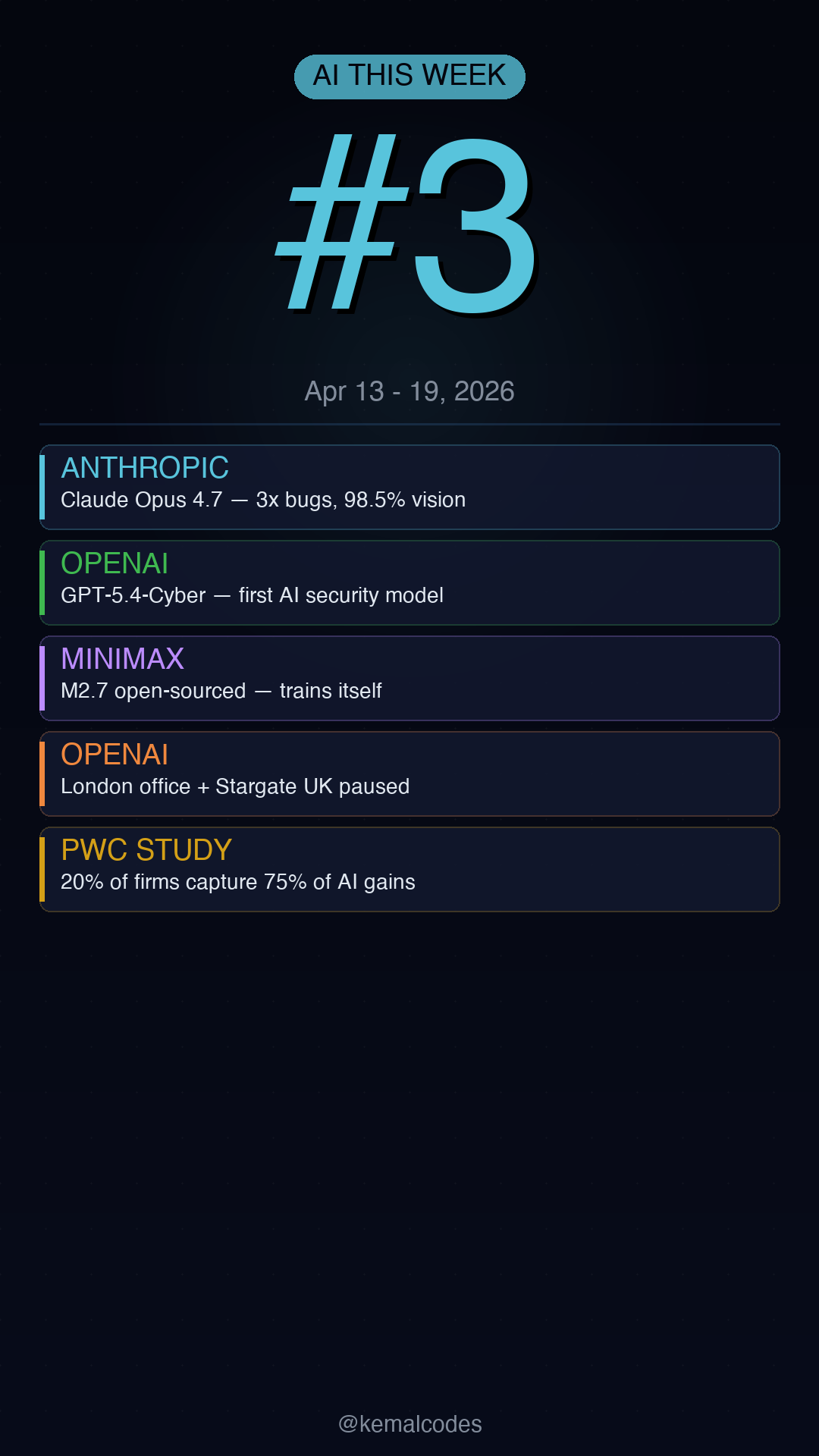
Here are the 5 biggest AI stories from the week of April 13–19, 2026.
1. Anthropic: Claude Opus 4.7
Anthropic released Claude Opus 4.7 this week. The headline numbers:
- 3× more production bugs fixed on SWE-bench compared to the previous model
- 98.5% on vision tasks — near-perfect image understanding
- New
/ultrareviewcommand in Claude Code for deeper code analysis
The catch: Opus 4.7 uses a new tokenizer that adds up to 35% more tokens on code-heavy tasks, which increases cost even though the per-token price stayed the same. If you work with a lot of code, run the math on your current usage before upgrading.
2. OpenAI: GPT-5.4-Cyber
OpenAI launched GPT-5.4-Cyber, its first model built specifically for defensive security work.
Key capabilities:
- Reverse-engineers binaries without access to source code
- Analyzes malware and suspicious code at a level previous models couldn’t
- Tiered access — you need to apply through OpenAI’s Trusted Access for Cyber program to get in
This is not a public release. It’s aimed at security researchers and vetted organizations. But it signals that OpenAI is taking the security tooling market seriously.
3. MiniMax: M2.7 Open-Sourced
Chinese AI lab MiniMax open-sourced M2.7, a 229B parameter model.
What stands out:
- The model was partially used in its own training pipeline — it helped train itself
- 56% on SWE-Pro, a demanding software engineering benchmark
- Available for free on Hugging Face, and compatible with Ollama for local inference
A 229B model that runs on Ollama is a big deal for anyone who wants a capable local model. It’s not lightweight, but if you have the hardware, it’s worth testing.
4. OpenAI: London Office + Stargate UK
Two conflicting OpenAI UK news items dropped in the same week:
- OpenAI opened its first permanent London office, signaling long-term commitment to the UK market
- Stargate UK, the planned £100B AI infrastructure project, was paused due to a funding review
The pause doesn’t mean the project is cancelled, but it does mean the timeline is unclear. The contrast between opening a permanent office and pausing a flagship infrastructure program in the same week raised a lot of questions.
5. PwC Study: The AI Gains Gap
A PwC study this week found that just 20% of companies are capturing 75% of AI’s economic gains.
The dividing line is not industry or company size — it’s how deeply AI is integrated into core workflows. Companies that treat AI as a productivity tool for individual workers are falling behind. Companies that rebuild processes around AI are pulling ahead.
The gap is getting wider, not narrower.
Watch the Short
I break down all 5 stories in under 90 seconds on YouTube: