OpenCode vs Claude Code vs Codex: The AI Agent War Nobody Planned

In January 2026, Anthropic made a quiet change. They blocked Claude Pro and Max subscribers from using Claude through third-party tools. No announcement. No warning. Tools like OpenCode just stopped working overnight. The backlash was immediate. David Heinemeier Hansson — the creator of Ruby on Rails — posted on X: “Confirmation that Anthropic is intentionally blocking OpenCode, and any other 3P harness, in a paranoid attempt to force devs into Claude Code. Terrible policy for a company built on training models on our code, our writing, our everything.” ...

April 17, 2026 · 7 min
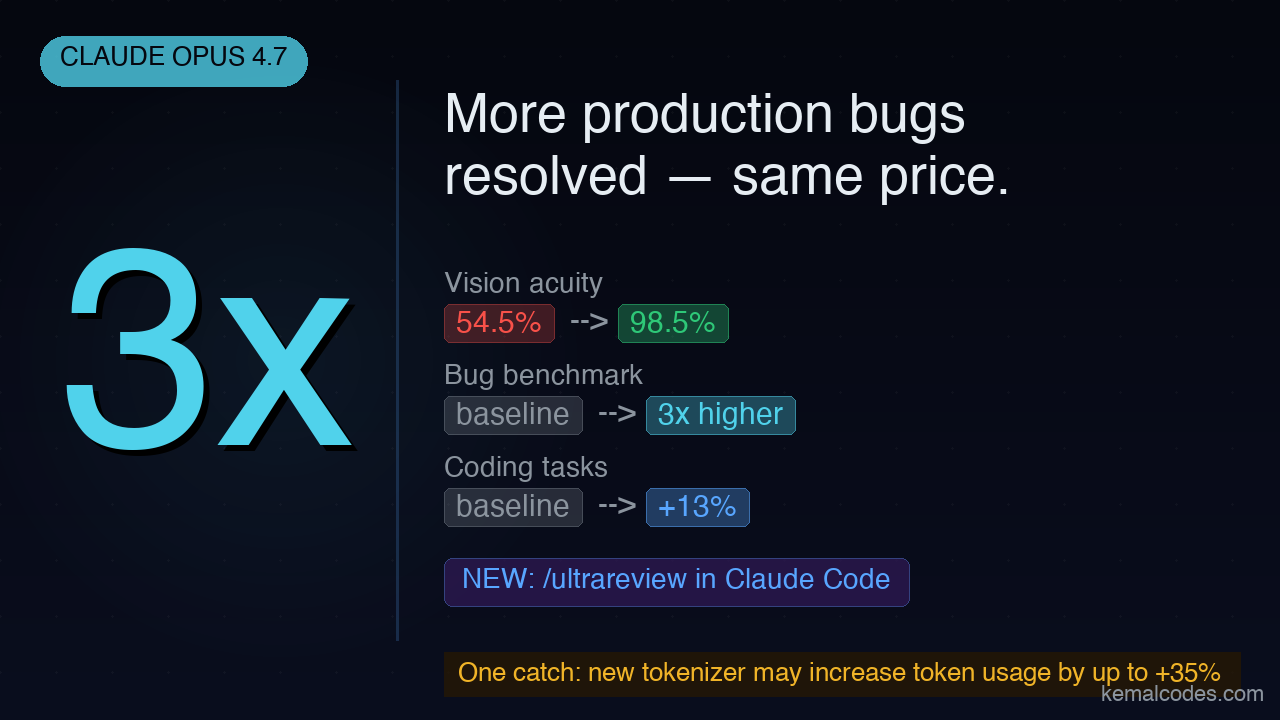
Claude Opus 4.7 — 3x more production bugs resolved, 98.5% vision acuity

Claude Opus 4.7: The Upgrade Developers Actually Wanted

Anthropic released Claude Opus 4.7 on April 16, 2026. Same price as 4.6. But three times more production bugs resolved on the benchmark that matters most to developers. Here is everything that changed — and the one real catch. The 3x Claim: What It Actually Means The “3x” number comes from SWE-bench Verified, specifically the Rakuten production bug subset. SWE-bench is the standard benchmark for AI coding. It gives a model real GitHub issues from real open-source projects. The model has to produce a working fix — not a suggestion, not a comment. A fix. ...

April 16, 2026 · 4 min

Claude Mythos: The AI Too Dangerous to Release

Anthropic just built its most powerful model — and decided not to release it to the public. Claude Mythos Preview is real, and the reason it’s restricted has nothing to do with business strategy. It found thousands of zero-day vulnerabilities across every major operating system and every major web browser. Some of those bugs had been hiding for decades. What Is Claude Mythos Preview? Claude Mythos Preview is Anthropic’s most capable model, released April 7, 2026 — but only to a restricted set of security partners. ...

April 12, 2026 · 4 min

How to Set Up Automated AI Code Reviews on GitHub (Step by Step)

Every pull request in your repo should be reviewed. But manual code reviews take time — often 2-4 hours per PR. And reviewers miss things when they are tired or rushed. AI code review tools read every PR automatically and leave comments in minutes. Not replacing human reviewers — augmenting them. The AI catches the obvious bugs, the human reviewer focuses on architecture and business logic. Here is how to set it up on GitHub. Three options — from easiest to most customizable. ...

April 11, 2026 · 7 min

5 Claude Code Tricks Most Developers Don't Know

Most developers use Claude Code like a chatbot. Type a question, get an answer, copy the result. That is maybe 20% of what it can do. Here are 5 tricks that change how you work. 1. The ! Prefix — Run Shell Commands Instantly Type ! before any shell command in the chat and Claude runs it immediately — and reads the output. ! git log --oneline -5 ! npm test ! docker ps ! cat package.json Claude sees the result as part of your conversation. No copy-pasting terminal output into the chat. No switching windows. ...

April 10, 2026 · 4 min

How I Use AI Coding Tools Every Day — My Complete Workflow (2026)

Everyone writes about AI tools. Nobody shows how they actually use them day to day. Here is my real workflow — which tools I open, when I use each one, what works, what fails, and what it actually costs. No sponsored content. Just what I do. My Daily Setup Three screens. Two AI tools always running. One browser tab. Left screen: Cursor (main code editor) Right screen: Terminal with Claude Code Browser: Claude.ai or ChatGPT for quick questions That is it. No 10 tools. No complex setup. Two AI coding tools and a chat window. ...

April 10, 2026 · 8 min

Anthropic Advisor Tool: Near-Opus Agent Performance at Lower Cost

Anthropic launched the Advisor Strategy on April 9, 2026 — a way to get near-Opus intelligence in your AI agents at a fraction of the cost. The idea is simple. Instead of running Opus on every request, you pair a cheaper model with Opus as an on-demand advisor. The cheap model does all the work. Opus only steps in when needed. How It Works You have two roles: Executor — Sonnet or Haiku. Runs every turn. Calls tools, reads results, makes decisions. Advisor — Opus. Runs on-demand only. Reviews the shared context and sends guidance when the executor is stuck. The executor and advisor share the same context: the system prompt, tool definitions, full conversation history, and all prior tool results. When the executor hits a hard decision, it calls the advisor tool. Opus reviews the full context and sends back a plan or correction. Then the executor continues. ...

April 9, 2026 · 3 min

Edge AI Agents: Running AI on 1MB RAM with Zig, Rust, and Small Models

Every AI agent we have discussed so far needs the cloud. You send a prompt to Claude or GPT, wait for a response, and pay per token. That works for coding and content generation — but what about a sensor on a factory floor? A camera in a farm? A device with no internet? That is where edge AI comes in. Running AI models directly on the device — no cloud, no latency, no API costs. ...

April 9, 2026 · 7 min

AI-Native Apps: How to Build Applications with AI as Core Logic (2026)

Most “AI apps” in 2023-2024 were wrappers. Take a text box, send it to ChatGPT API, display the response. That was it. In 2026, a new category is emerging: AI-native apps. These are applications designed from the ground up with AI as the core logic — not an add-on feature. The difference matters. And understanding it will change how you build software. What is an AI-Native App? An AI-native app is an application where AI is the primary logic engine, not a helper feature. ...

April 8, 2026 · 8 min

MCP Explained: The Protocol Every AI Tool Now Uses

You have probably seen “MCP” everywhere lately. Every AI tool seems to support it now. But what is it actually? The problem before MCP Imagine you have 10 AI tools and 20 data sources. Databases, APIs, file systems, Slack, GitHub. Each AI tool needed its own custom integration with each data source. That is 200 different integrations to build and maintain. Developers called this the N×M problem. What MCP does Model Context Protocol is a standard. Like USB-C, but for AI. ...

April 6, 2026 · 3 min